Medicine has absorbed a great many technologies that promised transformation and delivered incremental improvement. Machine learning looked, for years, like another entry on that list. It is no longer reasonable to describe it that way.
Structural biology has been genuinely reordered. Diagnostic imaging is being reorganised around algorithmic triage. Early-stage drug discovery timelines have compressed measurably. At the same time, the failure modes are becoming clearer - and they matter as much as the successes.
Why This Matters Right Now
Three developments have moved from research novelty to routine practice.
Protein structure prediction went from an unsolved grand challenge to a standard laboratory tool within a few years, with predicted structures now available for essentially the entire known protein universe.
Medical imaging models have been cleared by regulators in significant numbers for specific, narrow tasks - detecting large-vessel occlusion on a CT scan, flagging diabetic retinopathy, prioritising radiology worklists.
Generative chemistry has begun producing candidate molecules that reach human trials, compressing the earliest phase of discovery from years into months.
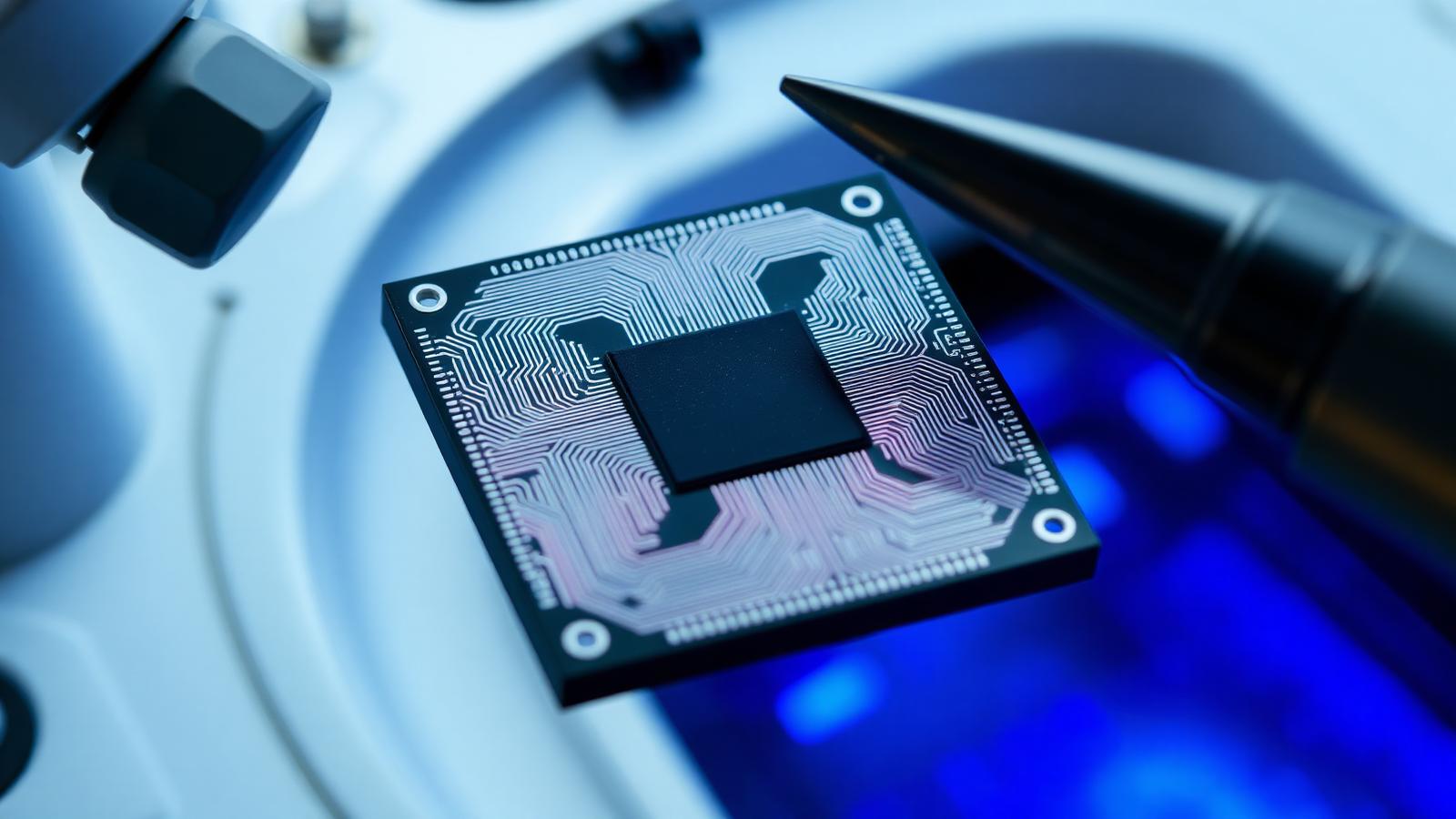
Image placement: after the introduction. ALT text: "Macro photograph of a microchip under laboratory light representing computational biology".
Background: Where AI Fits in the Drug Pipeline
Bringing a medicine to market traditionally takes ten to fifteen years and costs well over a billion dollars once failures are accounted for. The pipeline has distinct stages, and AI is far more useful in some than others.
- Target identification - deciding which biological mechanism to attack. Machine learning on genomic and clinical datasets is genuinely productive here.
- Hit discovery and lead optimisation - finding and refining molecules. This is where generative models have made the clearest gains.
- Preclinical testing - toxicity and pharmacokinetics. Prediction helps, but does not replace laboratory work.
- Clinical trials - three phases in humans. This consumes the majority of time and cost, and AI's contribution is mostly operational: patient recruitment, site selection, trial monitoring.
This distribution matters. The stage AI accelerates best is not the stage that dominates the timeline. Compressing discovery from four years to one is valuable, but it does not compress a seven-year clinical programme.
The Latest Developments
Structure prediction has become infrastructure
Predicted protein structures are now a default starting point rather than a research result, and the field has moved on to predicting complexes, interactions and dynamics.
Diagnostics are being deployed as triage, not diagnosis
The successful deployment pattern is narrow and assistive: the model flags and prioritises, a clinician decides. Attempts at autonomous diagnosis have encountered both regulatory and liability resistance.
Generalisation remains the central weakness
Models trained at one institution frequently degrade when deployed at another, because scanner hardware, patient demographics and clinical protocols differ. External validation is now the key quality signal in the literature.
Regulators have built dedicated pathways
Adaptive frameworks for continuously learning systems now exist, with requirements for change control, real-world performance monitoring and transparency about training data.
Image placement: within the "Latest Developments" section. ALT text: "Line and bar chart on white paper representing clinical trial and research data".
Key Facts
- Predicted structures are now available for hundreds of millions of proteins, effectively covering the known proteome.
- Historically, roughly 90 per cent of drug candidates entering human trials fail to reach approval - the base rate AI must improve on to matter.
- Several hundred AI-enabled medical devices have received regulatory clearance, with radiology accounting for the large majority.
- Clinical trials typically consume 60 to 70 per cent of total development time.
Expert Perspectives
Computational biologists are broadly optimistic about the discovery stage, while cautioning that a predicted structure is a hypothesis, not a validated finding.
Clinical researchers are more restrained. Their consistent point is that the bottleneck is biological uncertainty, not computational speed. If the chosen target is wrong, generating better molecules against it faster does not help.
Health services researchers raise a distinct concern: equity. Training datasets underrepresent large populations, and a model that performs well on the population it was trained on may perform materially worse elsewhere. Without deliberate correction, AI could widen rather than narrow health disparities.
Real-World Impact
On patients
The nearest-term benefits are in speed of triage - faster identification of strokes, earlier flagging of diabetic eye disease, shorter reporting backlogs. Novel AI-discovered medicines remain years from routine prescription.
On health systems
Radiology and pathology workforce shortages are severe in many countries. Triage models that safely reduce reading burden address a real operational crisis, which is why adoption has been fastest there.
On research economics
Lower discovery costs could make rare-disease programmes viable that previously were not - potentially the most socially significant effect of all.
On data governance
Model quality depends on data access, which collides with patient privacy. Federated learning and synthetic data are the leading technical responses; neither is fully mature. The underlying compute requirements connect to the infrastructure story in our report on AI data centres and power grids.
Key Takeaways
- Protein structure prediction is a genuine, settled breakthrough.
- Imaging AI works best as narrow triage under clinical supervision.
- The clinical trial stage still dominates timelines and is least affected.
- Generalisation failure across institutions is the main deployment risk.
- Dataset representativeness is an equity issue, not only a technical one.
Frequently Asked Questions
Has AI actually produced a new approved medicine? Several AI-discovered candidates have entered human trials, and early-phase results have been reported. Full approval requires the standard multi-year clinical programme, so definitive answers are still pending.
Can AI replace radiologists? Not on current evidence. Cleared systems perform specific tasks within a workflow overseen by clinicians; general interpretive judgment remains human.
Is AI diagnosis safe? Where it is narrow, externally validated, regulated and monitored, evidence supports benefit. Unvalidated general-purpose chatbots used for self-diagnosis are a different and riskier category.
Conclusion and Outlook
The realistic expectation is compression at the front of the pipeline and improvement in the operational efficiency of the rest - substantial, cumulative gains rather than a single dramatic leap.
Watch three signals: phase II and III results for AI-discovered candidates, prospective multi-site validation studies for diagnostic models, and the emergence of enforceable dataset representativeness standards.
Continue with our Health & Science coverage and our Technology section.
Sources and further reading: World Health Organization, Nature, US Food and Drug Administration.
Would you accept an AI-assisted diagnosis? Tell us in the comments.