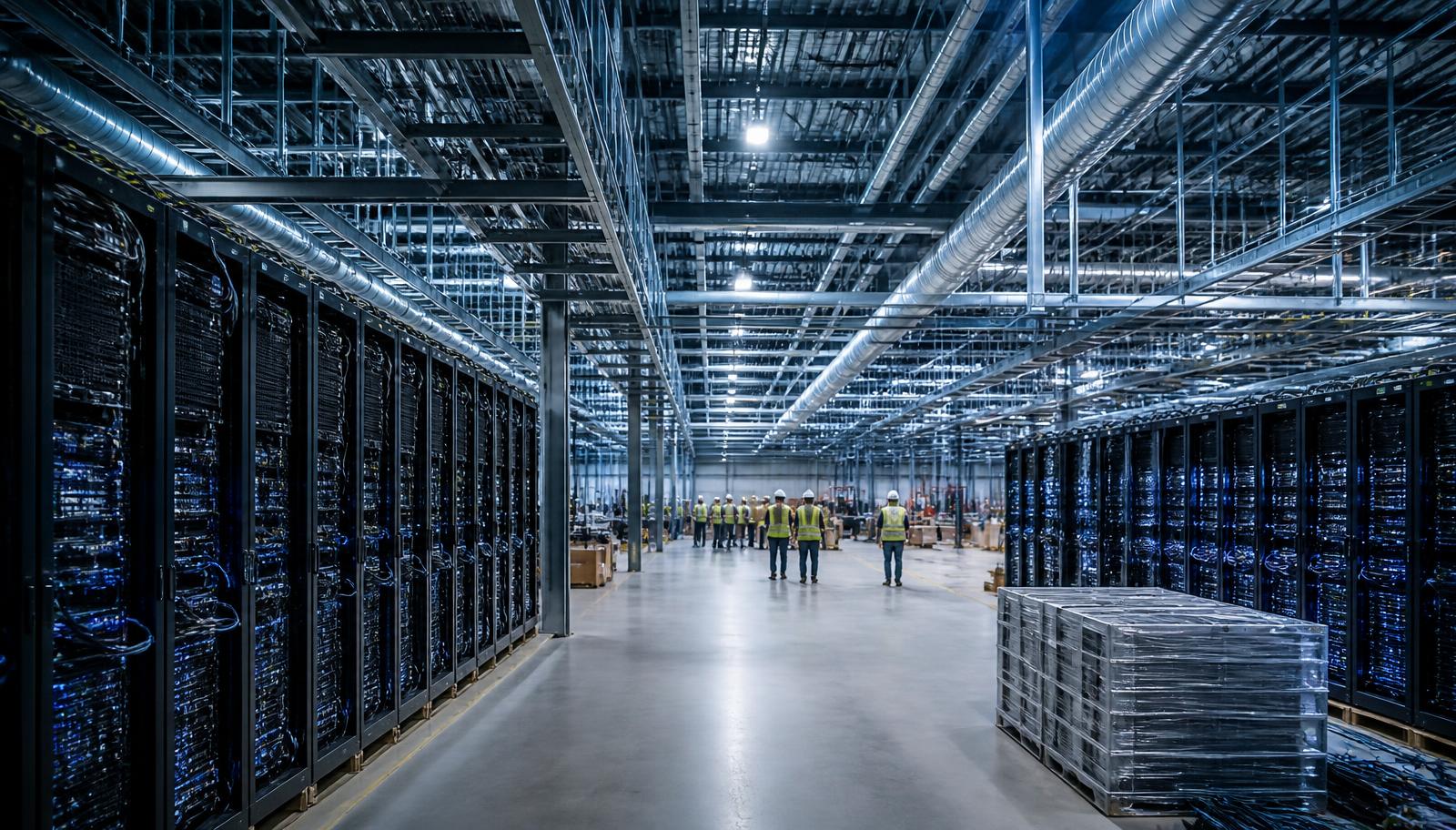
Artificial intelligence stopped being a software story some time ago. It is now, first and foremost, a story about concrete, copper and electricity. Every fluent answer produced by a large language model is the visible end of an industrial chain that runs back through accelerator chips, liquid cooling loops, high-voltage substations and, ultimately, national power grids that were never designed for this kind of demand.
That collision - between exponential compute growth and linear grid expansion - is now one of the defining infrastructure problems of the decade. It affects electricity prices, industrial policy, water use, and the pace at which AI products actually reach the public.
Why This Matters Right Now
For most of the last twenty years, data centres were an efficiency success story. Server workloads grew enormously while total electricity consumption stayed comparatively flat, because each generation of hardware did far more work per watt.
Generative AI broke that pattern. Training and serving frontier models requires dense clusters of accelerators that draw far more power per rack than traditional servers. A conventional rack might draw 5 to 10 kilowatts. AI training racks are routinely specified at 40 to 130 kilowatts, and next-generation designs push higher still.
The result is a step change rather than a gentle curve, and grid operators plan in decades, not quarters.
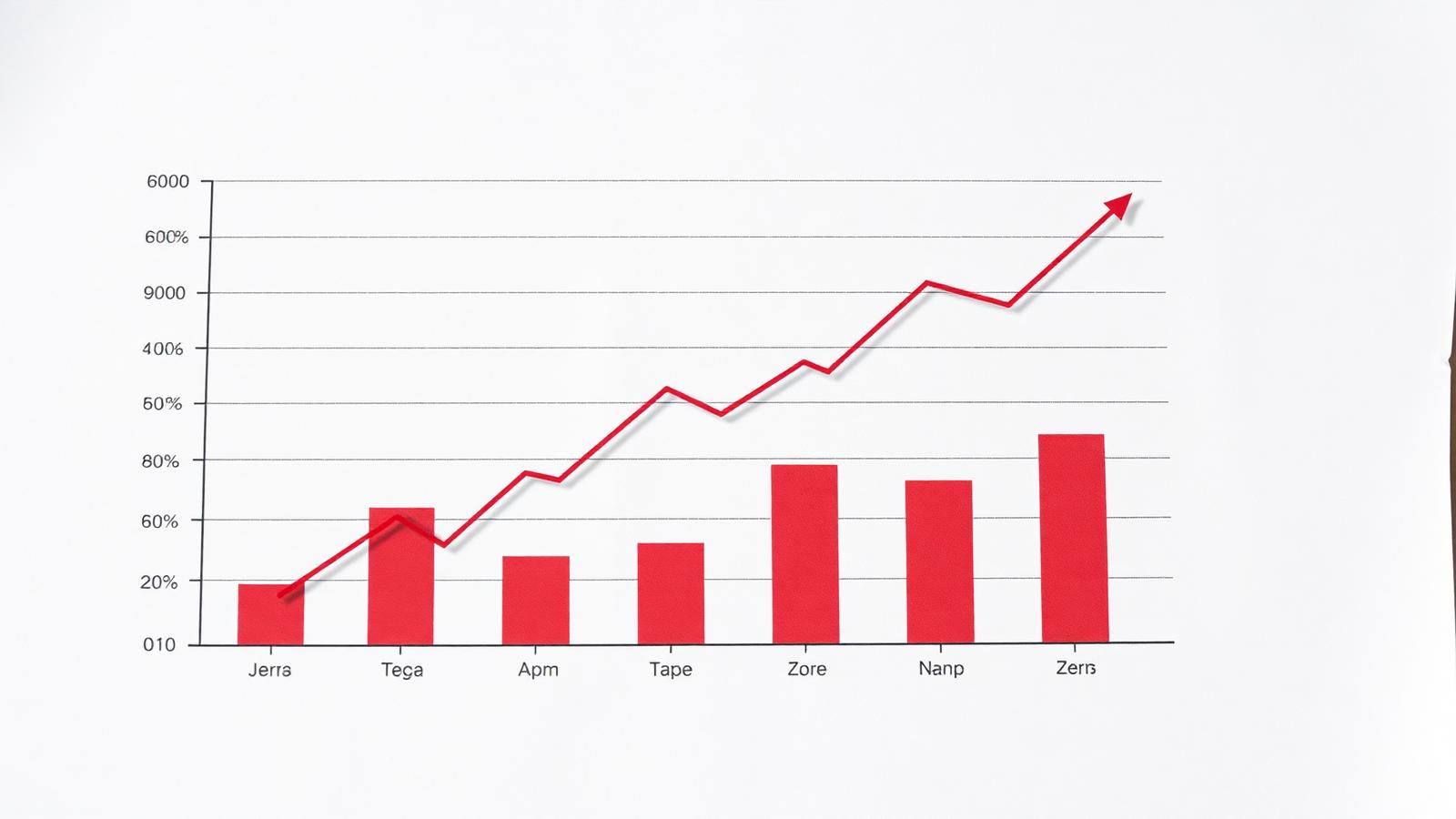
Image placement: after the introduction. ALT text: "Red line and bar chart on white paper showing rising data centre electricity demand".
Background: How a Data Centre Actually Uses Power
To follow the debate, it helps to understand where the electricity goes.
- Compute - the accelerators and CPUs doing the actual mathematics. This is the largest and fastest-growing share.
- Cooling - removing heat from dense racks. Air cooling struggles above roughly 30 kilowatts per rack, which is why the industry is shifting to direct-to-chip liquid cooling.
- Power conversion and distribution - losses in transformers, uninterruptible power supplies and distribution units.
- Networking and storage - comparatively modest, but non-trivial at scale.
Efficiency is measured with PUE, or power usage effectiveness: total facility energy divided by IT energy. A PUE of 1.1 means only ten per cent overhead. Hyperscale operators have pushed close to that number, which is genuinely impressive - but it also means the easy efficiency gains have largely been harvested. Further growth in compute now translates almost directly into further growth in electricity demand.
The Latest Developments
1. Grid connection queues have become the bottleneck
In several major markets, the constraint is no longer capital or chips. It is the wait for a grid connection. Developers in parts of Northern Virginia, Dublin, Amsterdam, Singapore and London have faced multi-year queues or outright moratoria on new large loads. Ireland's grid operator has restricted new data centre connections in the Dublin region, and the Netherlands and Singapore have both used planning rules to slow growth.
2. Operators are buying their own generation
Unable to wait, the largest buyers have moved upstream. Long-term power purchase agreements for wind, solar and nuclear output have become standard. Several operators have signed deals to restart or underwrite existing nuclear capacity, and gas turbines are being installed on site as bridging capacity - a development that complicates corporate climate targets.
3. Chip supply is easing, power supply is not
Accelerator lead times have improved as manufacturing capacity expanded. Transformer and high-voltage switchgear lead times have gone the other way, in some cases stretching past two years. The physical grid equipment is now the scarce good.

Image placement: within the "Latest Developments" section. ALT text: "Macro photograph of a semiconductor chip under a microscope in a cleanroom".
Key Facts and Figures
- Data centres accounted for roughly 1 to 1.5 per cent of global electricity use before the generative AI wave, according to International Energy Agency analysis.
- Credible projections now place data centre demand in a range that could roughly double by the end of the decade, with AI the dominant driver of the increase.
- A single large AI campus can be specified at several hundred megawatts to more than a gigawatt - comparable to the output of a nuclear reactor.
- Cooling water is a parallel constraint: evaporative systems can consume millions of litres a year, which is politically sensitive in drought-exposed regions.
- Rack power density has increased by roughly an order of magnitude in less than a decade.
Treat forward-looking numbers with care. Demand forecasts in this sector have a poor track record in both directions, and much depends on efficiency gains that have not yet materialised.
Expert Perspectives
Three broad camps have formed among energy analysts and infrastructure economists.
The constraint camp argues that physics wins. Turbines, transformers and transmission lines take years to build, permit and energise, and no amount of software optimisation removes that lag. On this view, compute growth will be rationed by the grid.
The efficiency camp points to history. Each hardware generation has delivered large improvements in performance per watt, model architectures are becoming cheaper to run, and inference optimisation is still immature. Demand curves, they argue, will bend.
The relocation camp expects the map to change rather than the total. Training workloads are relatively insensitive to latency, so they will migrate toward cheap, abundant power - the Nordics, the Gulf, parts of Canada, Latin America and Africa - while latency-sensitive inference stays close to users.
All three are probably partly right, and the balance between them determines who pays.
The Real-World Impact
On household bills
Where new large loads arrive faster than new generation, wholesale prices rise. The distributional question - whether data centre developers or ordinary ratepayers fund grid upgrades - is now an active political fight in several jurisdictions, and regulators are beginning to design large-load tariffs specifically for this purpose.
On climate targets
AI demand is growing faster than clean generation can be added in most markets. In the short term, that risks extending the life of fossil plants. In the medium term, it has made corporate buyers among the largest financiers of new clean capacity on earth - a genuinely double-edged outcome.
On local communities
Data centres deliver substantial tax revenue and construction employment but relatively few permanent jobs. Planning disputes increasingly turn on land use, water, noise and grid priority rather than on technology.
On geopolitics
Countries with cheap, firm, low-carbon electricity now hold a strategic asset. Compute capacity is being treated as national infrastructure, with sovereign AI programmes appearing across the Gulf, Europe and Asia. This connects directly to the trade and tariff pressures we cover in our analysis of the new tariff walls.

Image placement: before the Key Takeaways. ALT text: "Aerial view of a container port at dusk representing global technology supply chains".
Key Takeaways
- AI has turned computing into an energy-intensive heavy industry.
- Grid connections, transformers and switchgear - not chips - are the current bottleneck.
- Data centre electricity demand is plausibly on track to roughly double this decade.
- Households may absorb part of the cost through network charges unless regulators intervene.
- Regions with abundant, firm, low-carbon power are gaining lasting strategic advantage.
Frequently Asked Questions
How much electricity does a single AI query use? Estimates vary widely by model and hardware, but a text query is generally in the range of a few watt-hours - materially more than a conventional web search, though small relative to household appliances. The aggregate matters far more than the individual query.
Will efficiency improvements solve the problem? They will slow it. Historically, however, efficiency gains have been reinvested in more compute rather than lower consumption - the classic rebound effect.
Do data centres raise consumer electricity prices? They can, particularly where demand growth outpaces generation and where grid reinforcement costs are socialised across all users. The regulatory design of large-load tariffs is decisive.
Is nuclear power the answer? It is part of one. Nuclear provides firm, low-carbon output well matched to constant data centre load, but new build timelines are long. Restarting or uprating existing plants is the faster path.
Conclusion and Outlook
The next phase of artificial intelligence will be decided less in research laboratories than in permitting offices, substation yards and regulatory hearings. The strategic question for governments is no longer whether to host AI infrastructure but on what terms - who funds the grid, who gets connection priority, and how the benefits are distributed.
Expect three developments over the next two years: purpose-built large-load tariffs in major markets, faster migration of training workloads to energy-rich regions, and increasing political attention to water as well as watts.
For continuing coverage, follow our Technology section and our reporting on markets and the wider economy.
Sources and further reading: International Energy Agency, Reuters technology coverage.
Found this useful? Share it with a colleague, and tell us in the comments how energy costs are affecting your industry.